

Unlocking the Secrets to a Longer, Healthier Life
Have you ever wondered how many healthy years you have left? Surprisingly, your body holds some of the answers. Two key indicators can give you a remarkable insight into your future health:
- Grip Strength: Is a powerful predictor of your remaining healthy years.
- VO2 Max: Your cardiorespiratory fitness level is another critical indicator.
Together, these metrics provide a comprehensive picture of your potential for a long, healthy life filled with mobility, independence, and overall well-being. The good news? No matter where you stand now, there's always room for improvement.
In the sections below, we'll dive deeper into why these factors matter, how you can measure your own, and practical steps to boost your scores and extend your healthy years.
1) Grip Strength is a Brilliant Predictor of All-Cause Mortality
Grip strength isn't just a measure of hand power; many studies have shown it to be a surprisingly accurate indicator of overall health and longevity. A stronger grip correlates with a lower risk of all-cause mortality, making it a brilliant predictor of how long you might live. This simple test reflects your overall muscle strength across the body, which is linked to a variety of health outcomes.
Stronger grip strength has been associated with lower risks of cardiovascular disease, respiratory illness, and even certain types of cancer. It's also an indicator of better mobility, reduced risk of falls, and greater resilience against age-related decline.
Grip Strength Correlates with Brain Health
Surprisingly, grip strength has also been shown to even correlate with cognitive performance. One notable study involving 476,559 individuals found a significant correlation between grip strength and both working memory and processing speed. In essence, the stronger you are, the better your brain works.
But how does this connection make sense? It's believed that good cognitive function is essential for effectively sending signals to your nerves that enable muscle contraction. The heavier the load to be lifted, the more neural activity is required, engaging more brain power. Thus, individuals who are stronger and capable of lifting heavier objects tend to have more robust nervous systems as well.
By maintaining or improving your grip strength, you're not just enhancing your physical capability but also boosting your chances of a longer, healthier life.
Measuring Grip Strength
You can buy a Grip Dynamometer relatively cheaply if you would like to track your grip strength over time. This one is £23 on Amazon. It's easy to use and tracks your progress over time too.
Or I also found this useful video on YouTube that shows you how to measure grip strength using old fashioned bathroom scales.

What Should Your Readings Be?
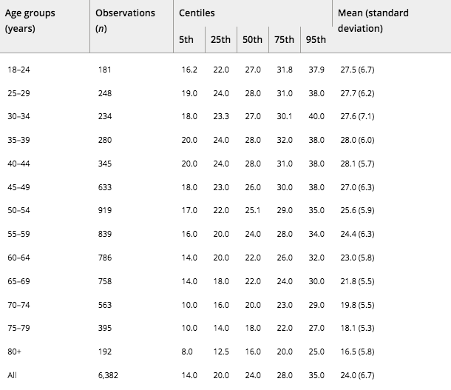
This Italian study of 11448 participants (56% women) found the following values for hand grip strength (kg) by age:
And for men they found:
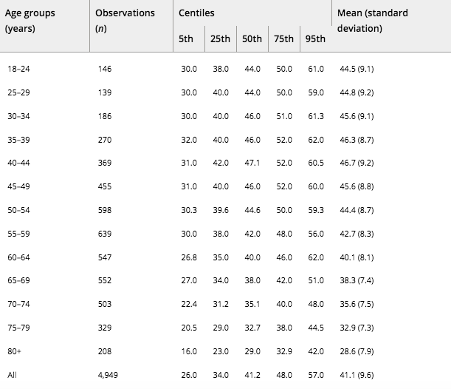
This is just one study however, but it gives you an idea where you fall. Obviously you want to aim to be in the higher percentiles for your age group.
If you are particularly interested in this there was a large British study who also looked at similar data or a German study that organised the data by height of participant.
Improving Grip Strength
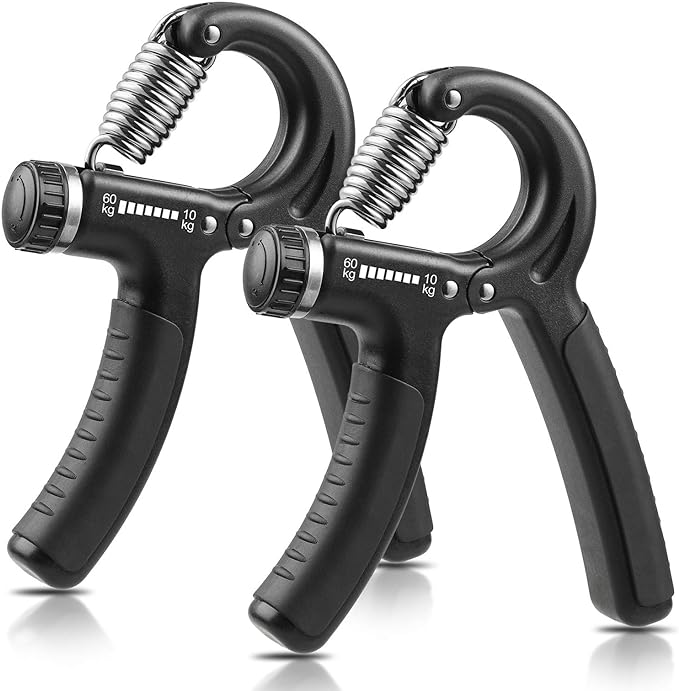
One option to improve grip strength is to use a grip strength trainer. Something like this one allows you to adjust the resistance and build up over time. This is great if you cannot do more advanced workouts for any reason.
But arguably your aim is not just to improve grip strength, but to have the goal of improving whole body strength. Therefore, in my opinion using dumbbells to improve your overall body strength would be a better idea. And as you progress with heavier weights, your grip strength will automatically also improve.
If you need help getting started with using dumbbells then we can work one-to-one together or if you are a woman you might like to consider joining my classes that are all based on lifting weights of various sizes.
2) Another Excellent Predictor of Long Term Healthy Years is VO2 Max Score
VO2max is the speed where that individual is ventilating, circulating and transporting the most oxygen that their body systems can handle.
Most people might be able to work at this speed for approximately three to 10 minutes before they have to stop, because this is the limit of what their aerobic system can do.
A large (122000 patients) study tracked the deaths over 1.1 million person-years of observation and found a strong relationship between cardio-respiratory fitness levels (measured using VO2max) and all-cause mortality. The graph below shows their results and the likelihood of participants dyeing.
- 25% of the participants fell into the category of low VO2max
- Below average was 25-50th percentile
- Above Average was 50 – 75 percentile
- High was 75-95th percentile
- Elite was 95th – 100th percentile

What this showed was that there are HUGE health gains to be made in chance of mortality for those in the bottom 25%. Just by exercising enough to move them out of the most unfit category to the below average group, still gave them a 50% reduction in mortality rate over 10 years. But even a small increase in VO2max, no matter in which category you currently fall, will make a difference to your life expectancy.
So what do we conclude from this?
Exercise matters! Move yourself out of that bottom half of the population and you’ll be much more likely to avoid disease and live a longer and most importantly healthier and more active life. It’s not just extra years of sitting in a chair.
How to Test Your VO2max
Some activity trackers estimate your VO2 max. Fitbit calls it your cardio fitness.
For Fitbit
- Go to your Fitbit app
- Click on heart
- Then your heart rate graph shows at the top – swipe along to the next image at the top. This is your cardio fitness score, similar to VO2 Max
On an Apple watch (series 3 and later)
- Open the Health app on your iPhone or iPad.
- If you’re on your iPhone, tap the Browse tab. If you’re on your iPad, tap sidebarto open the sidebar.
- Tap Heart, then tap Cardio Fitness.
- Choose D, W or Y to view your average for the Day, Week or Year.
- Tap Show All Cardio Fitness Levels.
- Select a cardio fitness level to compare your results to other levels based on your age and sex
You can also tap the Show Information button in the top right to view the average cardio fitness levels for all ages for Female, Male or All.
If you don’t have a fitness tracker, probably the next easiest way to calculate your VO2 max without specialist equipment is using The Rockport Walking Test.
The Rockport Walking Test
You will need:
- 1-mile course (either 3.75 laps of a 400m running track or you can pace out a mile course using a pedometer/google maps).
- Stop watch.
Instructions
- Warm-up with light walking for 5 minutes.
- Walk (don’t jog or run) 1 mile as fast as you can.
- Record your time to walk 1 mile.
- Take your pulse for 15 seconds immediately after completing the mile. Multiply this number by 4 and enter it into the calculator.
- Enter your time for the one-mile walk in minutes and seconds into any rockport walk test calculator such as https://www.whyiexercise.com/rockport-walking-test.html
This test will give you your predicted VO2max score. Then find out how you are compare to others:

The Line of Independence
There is a level of VO2max called the ‘line of independence’ which is around 20 ml/kg/min for men and 16 ml/kg/min for women. At or below this figure is where people find it hard to live independently. The closer you are to this line, the closer you are to mortality. If your calculation is far away from these figures then you are doing well. If you are just above these numbers, you are probably doing OK right now, but you don’t have much room for manoeuvre.
Conclusion
Understanding and improving your grip strength, as well as your VO2 max, can provide significant insights into your overall health and longevity. These measures are not just about physical capability but are also closely linked to cognitive performance and resilience against various diseases. By focusing on enhancing these key indicators, you can take proactive steps towards ensuring a longer, healthier life. Embrace these simple yet powerful predictors to boost your mobility, independence, and quality of life for many years to come.