

NATURAL WAYS TO IMPROVE ARTHRITIS AND GOUT
Recently I’ve spoken to a number of people who have arthritis in some form or another. And I was asked; “what can they do to help improve their symptoms without drugs?” So, I set out on a mission to find out more. And I wanted to share what I found out with you.
The good news is, a lot can be done and how you live your life and what you eat will make a HUGE difference to the pain you experience and the movability of your joints.
What is arthritis?
Arthritis is the inflammation of joints. It presents itself as joint pain, swelling, tenderness and stiffness. Often you can see an arthritic joint by the bony spurs that stick out from it. Skin can be redder too. Everything discussed here will help with arthritis, osteoarthritis, rheumatoid arthritis and gout.
Causes of arthritis
There is no one definitive answer to what the cause of arthritis is, but we know that a few things put you at higher risk:
- Possibly an acid environment in the cells
- Old injuries to joints
- Inherited genes
Foods to help alleviate arthritis symptoms
There is some controversy over which foods make arthritis better or worse. Anecdotally a lot of people report an alkaline diet really helping. Some believe that arthritis loves an acid environment in your cells, so if you eat an acidic diet this makes it worse.
The pH of your blood always stays constant, but the pH of your cells is affected by a number of factors, including the food that you eat. As with all diets, the best way of finding out if it works for you is by trying it. Try for a month and see whether there are any changes in your symptoms.
The list of foods you need to eat and restrict are determined by the acid production in the body once eaten. You need to eat 80% alkaline foods and only 20% acid forming foods.
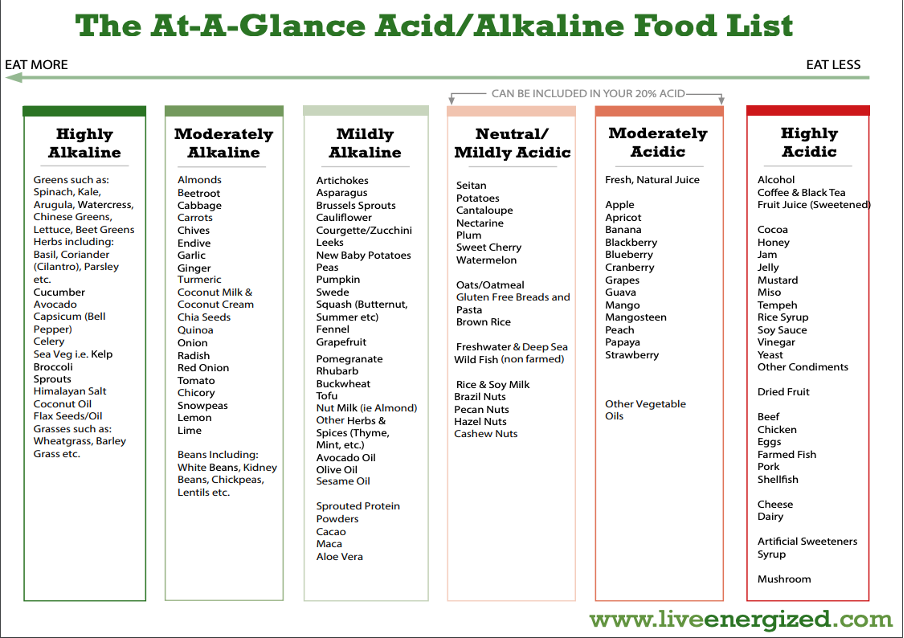
You can download a fuller list of food items from Live Eneregized here.
Roughly speaking, alkaline foods include things like:
- Veggies: green foods, lemons (are acid in the stomach, but when broken down and the minerals absorbed by tissues the minerals are alkalising – sodium, potassium, calcium, magnesium and iron), leafy foods, salads, lettuce, kale, spinach, cucumber, carrots, beets, herbs, sweet potato, bell pepper, arugula, broccoli, cauliflower, ginger, turmeric, coriander, basil, avocado etc. Note: Some people believe the nightshade vegetables (tomatoes, peppers, aubergines, white potatoes) should be avoided – so try out for yourself what works for you. How does your arthritis feel after eating these?
- Beans & Pulses: lentils, butter beans, chickpeas, kidney beans, navy beans, organic soy etc
- Low-Sugar Fruits: tomato, avocado, lime, lemon, grapefruit etc.
- Gluten Free Grains & Grasses: gluten free oats, quinoa, chia, buckwheat, amaranth etc.
- Nuts, Seeds & Healthy Fats: coconuts, coconut oil, almonds, sunflower seeds, flax seeds etc.
- Non-Dairy Milks: coconut milk, almond milk etc.
- And In Moderation: oily fish, fresh fruit, organic grass-fed/pasture-raised/free-range meat
And acid-forming foods are things like:
- Sugar and sweeteners
- Gluten-containing grains: oats, barley, rye, semolina, all flours not labelled gluten-free, wheat and flour products, pizza, pasta, battered foods
- Excessive animal protein
- Trans-fats, oxygenated fats
- Dairy: Some people believe goats cheese is ok however
- Additives and preservatives, flavourings & colourings (natural or otherwise),
- Alcohol
- Caffeine: Tea and Coffee
- Chocolate
- Chips, refined foods, fast foods, fried foods
- Ultra-processed foods: oven meals, microwave meals, takeaways, cola and soda, and creamers...(basically a lot of the usual suspects!)
- And unfortunately, fermented foods are on this list too: fermentation makes foods acidic. Miso, tempeh, vinegar, kombucha etc. are all acid forming and should be avoided if you have arthritis (but do not avoid if you do not).
When you see these types of foods, it all makes sense. It's good, clean, healthy living with a focus on avoiding the most acidic, oxidising, inflammation-causing foods, and a big focus on those alkaline, nutrient-dense, antioxidant-rich, anti-inflammatory foods. And actually, looking at the list, it is similar to my 21 Day Reset if you want some help eating this way.
So if you typically start your day with with a slice of toast and a cup of tea/coffee, you can see you're starting each day inflaming your joints from the get go. A few healthy swaps in your diet might make the world of difference and is surely worth a trial at the very least.
Just a little side anecdote too...I have a good friend who removed all her pain completely by taking a collagen supplement, a turmeric supplement and removed all ultra-processed foods form her life. I should add she also exercised quite a lot - played tennis.
Key Lifestyle Changes You Can Make to Improve Your Symptoms
- You want to draw blood flow towards your arthritic joints as the blood carries lots of healing nutrients and also carries away acidic waste products. So, exercising the joints in question to draw the blood to the joint is important. Keep it low impact however. If you are in a lot of pain swimming is great as the water supports you. You just need to get moving. Other exerise suggestions include:
- Exercise bike is also low impact and works well.
- Gentle bouncing on a rebounder where feet do not leave the surface. This just gets the blood flowing and also stimulates the lymphatic system which helps with toxins waste removal.
- If your arthritis is in your hand, you could do little gentle squeezes of a stress ball.
- Lying knee bend for hips - Bending and straightening your knees for one repetition when you are lying in bed. With both knees straight, slowly bend your sore leg by sliding your foot along the floor or bed towards you as far as is comfortable. Hold this position for 2 seconds before straightening your leg.
- Have a well oxygenated body. Oxygen has an alkalising effect. How do you get that? You do exercise that makes you breathe harder. You want to get a bit puffed out. A brisk walk may be sufficient if you are less fit. Also, sleeping with the window open to get fresh air can also help.
- Stay well hydrated (2 litres per day) sipping all the time throughout the day. This will aid the blood in pumping around your body.
- Get plenty of rest. Going to bed at the same time each night, but more important than that is getting up at the same time each morning. Then try to get out in daylight as soon as you can in the morning to give you strong circadian rhythms. Rest is essential to allow your body time for recovery and repair.
Some natural ideas for relieving the pain and swelling:
- Hot and Cold treatment: This will help move the blood along. 3 minutes hot, then 30 seconds cold x 3 rounds. Method will depend on what part of your body has arthritis. If it’s your hands, it’s easy, you can do 2 bowls of water, one with ice water and one with very hot water (obviously not hot enough to burn please), or you can use hot/cold packs that you can buy and put in freezer and microwave, or use a shower going from hot to cold. You should do this daily if you can.
- Use a ginger poultice - Chop up some fresh ginger and wrap in some material like a hanky. Put around your inflamed joint and then add a plastic layer of some sort to keep the heat in and clothes clean and then a bandage. This may feel very hot (as the ginger draws out the inflammation), so be careful not to burn yourself. If it becomes too hot, please remove it and if you wish try again another day. Leave for no more than 3 hours on your first try. You can repeat each day if you find it helped. Once you know it it works well for you, on subsequent occasions you can sleep with it on overnight if you wish (just not the first time).
- Castor oil poultice – Similar to the ginger one, but this time you douse the material in castor oil and then wrap plastic and then a bandage around. This is a gentler poultice and should help break down the congested areas of the body. You could alternate between ginger and castor oil poultices each day.
These are all long term things to do. Over many months some people have reported all the pain and swelling going. But you need to be consistent.
Good luck. I hope some of this helps. Please do comment below and let me know any results you get good or bad.
Sources:
Non-allopathic adjuvant management of osteoarthritis by alkalinisation of the diet https://pubmed.ncbi.nlm.nih.gov/26245599/
Ross Bridgeford https://learn.liveenergized.com/alkaline-food-chart-may-18
Barbara O'Neill How to heal arthritis naturally https://www.youtube.com/watch?v=dx5TcmOHZME
NHS https://www.nhs.uk/conditions/arthritis/